
Big things are happening in the world of remote wave energy control! The HAPiWEC project — our mission to make control design for wave energy converters faster, smarter, and more accessible — has reached some exciting new milestones. Whether you’ve followed us from the start or are just tuning in, here’s what’s new:
🚀 OSPREY-I: From Concept to Real-Time Testing
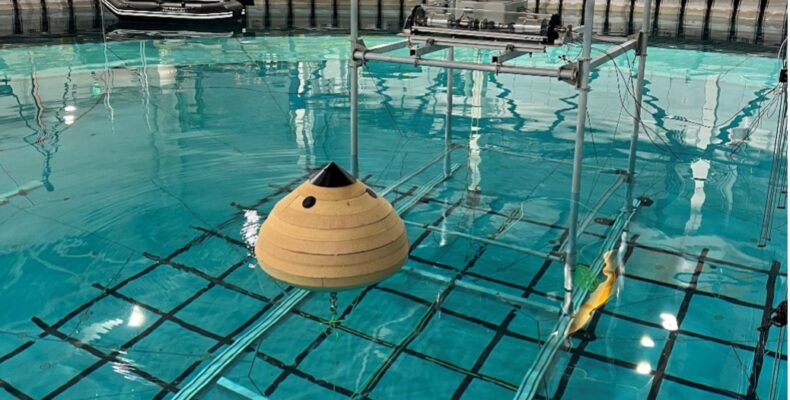
The OSPREY-I rig is officially up and running at the FloWave Ocean Energy Research Facility in Edinburgh! This lab-scale, multi-degree-of-freedom point absorber now supports remote testing of advanced control algorithms in real wave conditions. What makes it stand out? You can send your controller from anywhere in the world and see it tested on real hardware — without boarding a plane.
We’ve also rolled out Mk2 of the OSPREY-I design. It features a smarter mechanical layout using geared motors, modular components, and even easier adaptation for future WEC geometries. Built from off-the-shelf parts and a dash of 3D printing, the Mk2 is more robust, more flexible, and still replicable.
🧪 Miniwec: The Pocket-Sized Powerhouse
Need to validate communications, state machines, or signal processing before hitting the tank? Say hello to Miniwec, the compact sibling of OSPREY-I. It uses the same digital controllers and interfaces, making it the perfect sandbox for fast iteration — especially when experimenting with novel control architectures.
💻 Smarter Tools, Faster Prototyping
Our software stack just got a major upgrade:
OceanEdGE now includes live impedance tuning and mesh-based design tools.
IMPACT+ lets you build and refine controllers using intuitive, interactive interfaces.
HAPiGYM remains the heart of the system — where models, controllers, and test environments come together.
And yes, it’s all cloud-ready. Our REST APIs mean you can seamlessly connect your model designs straight into MATLAB-based workflows, without worrying about file versions or compatibility.
🌍 Remote Control, Real Impact
Using MQTT protocols, researchers can now securely interact with the high-level controller (a Raspberry Pi-based hub), update control policies, and stream data — all remotely.
Whether you’re running simulations, doing processor-in-the-loop testing, or commanding a motor in the tank, the remote GUI interface gives you full control with real-time feedback.
⚡ Controller Breakthroughs
The team has developed and tested new electrically-focused controllers, including:
OVT-E (Optimal Velocity Tracking – Electrical): Tuned for electrical power extraction, not just mechanical motion.
PI-E (Proportional-Integral – Electrical): Mimics impedance and adapts in real time using Extended Kalman Filters.
Both showed outstanding performance in simulations and are now being trialed with physical rigs. In fact, OVT-E not only boosted output but also reduced mechanical stress, hinting at longer device lifespans.
🔬 Co-Design in Action
We’re also bringing in control co-design. Using genetic algorithms, we’ve been evolving drive train geometries for sea-scale WECs — then scaling them down for lab testing. It’s a new way to link hardware design and control in one loop.
🚧 What’s Next?
With the foundation laid, we’re now focusing on:
Expanding the library of hydrodynamic models
Enhancing online user access and automation tools
Opening up HAPiGYM for more collaborative experiments
The dream? Letting any researcher — from students to seasoned experts — design, test, and improve wave energy control systems without barriers.
Thanks to the entire HAPiWEC team and our partners at FloWave, Heriot-Watt, and beyond. And to our fellow wave energy geeks: stay tuned — we’ve got a lot more to share soon 🌊⚡